


By Mia Chen, Family Safety & Smart Home Writer at Bestkid
Published September 16, 2026 · Product information checked September 15, 2026
A keypad on the outside of a door tells you how someone enters. It does not tell you how the same lock operates from inside.
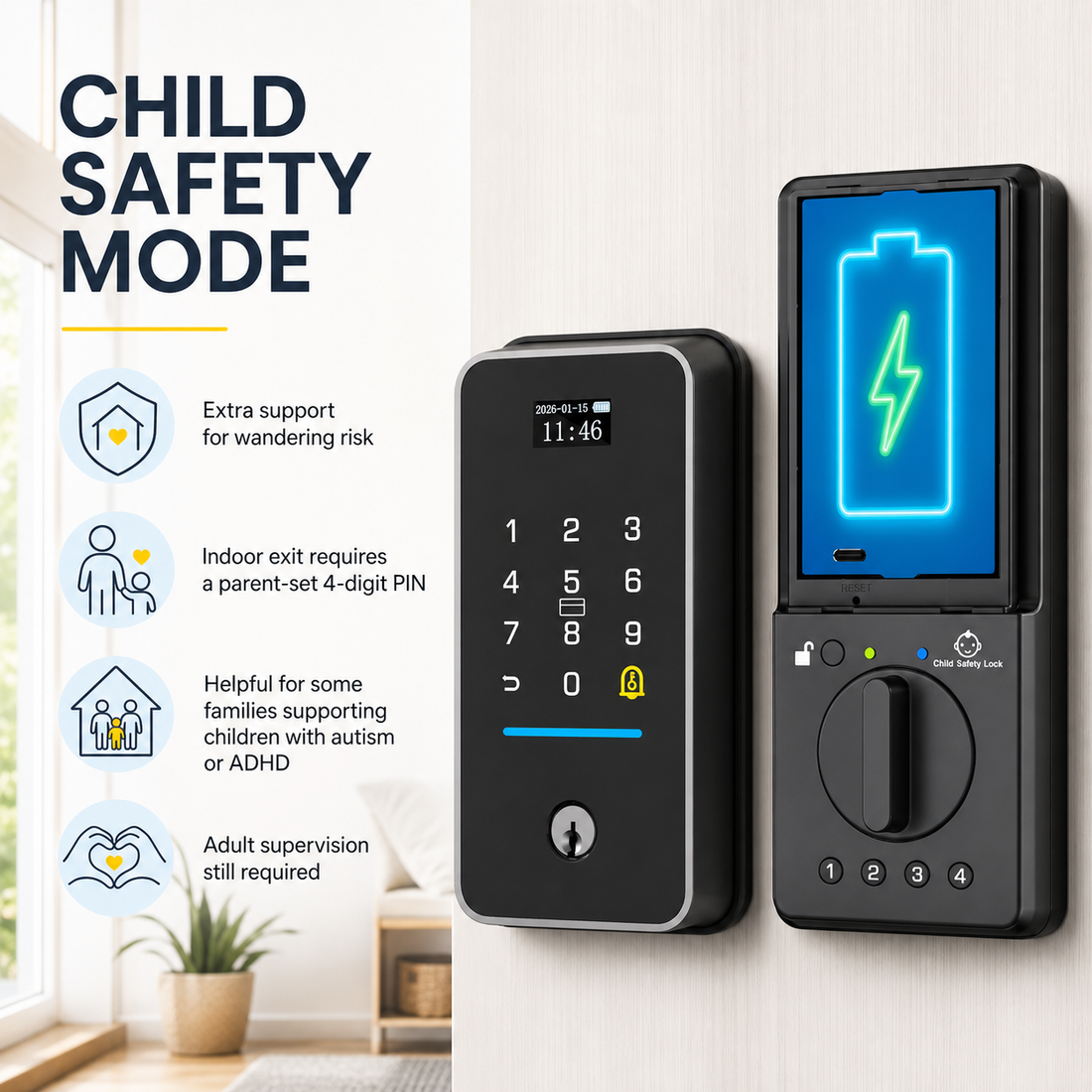
Families comparing interior access control may encounter two very different approaches: a double-sided keypad lock, with a coded interface on both sides, and a smart lock with an optional indoor PIN step, such as Bestkid MD11 in Child Safety Mode. Both can require an additional action before the door opens from inside. They should not be treated as interchangeable products.
This brand-authored guide compares the mechanisms and purchase questions. It is not an independent hands-on test, a medical recommendation or a statement that either design meets the fire or building rules for your door.
Safety first: Any lock mode that adds an interior release step can also delay emergency exit. Do not use a configuration that prevents an occupant from leaving promptly. Review the proposed installation with a qualified local installer or fire/building authority, and practice a household escape plan.
Key takeaways
- A double-sided keypad generally controls both directions with keypad hardware; an indoor-PIN smart lock may combine a special interior mode with several adult entry methods.
- Confirm the interior operation itself. An exterior keypad, fingerprint reader or mobile app does not prove that the inside release is controlled.
- Mechanical and connected products have different maintenance, credential and failure-planning requirements.
- Door dimensions, handing, bore preparation and clearance can decide compatibility before features do.
- Neither approach guarantees that a child will not leave, and neither replaces supervision or an emergency plan.
The short comparison
| Purchase question | Double-sided keypad lock | Smart lock with indoor PIN mode |
|---|---|---|
| What is on the interior side? | A second coded keypad or combination interface | A smart-lock interior assembly that can require a PIN when the relevant mode is enabled |
| Typical control style |

